Article
How to Read Guitar Chord Diagrams
Learn how to read guitar chord diagrams quickly. Understand dots, numbers, Xs, Os, and finger positions so you can play any chord chart at sight.
Popular fretboard positions with fingering suggestions
Showing 8 of 30 playable shapes
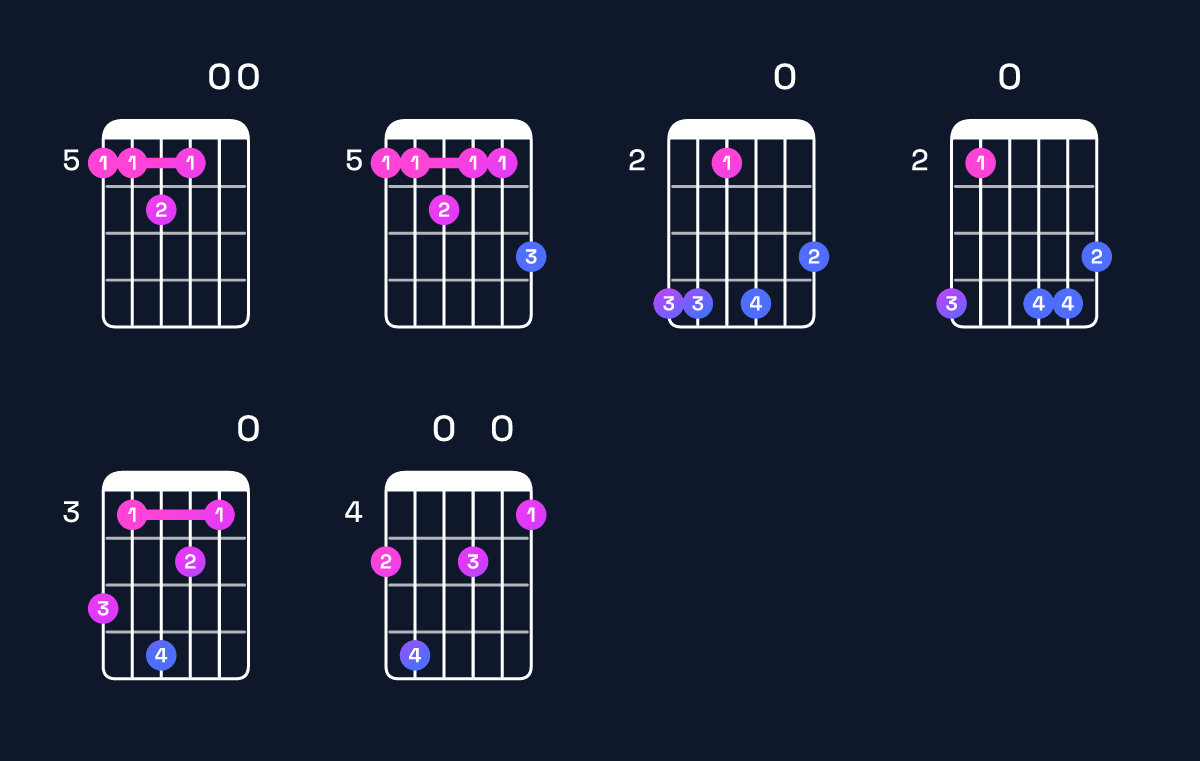
AmM11 is the A minor major 11 guitar chord. It uses the notes A, C, E, G♯, B, and D and the interval formula 1-♭3-5-7-9-11.
The A minor major 11 minor major 11 chord combines the minor major 7th with an eleventh D, producing a haunting, mysterious sound. The clash between the minor third C, major seventh G♯, and eleventh D creates a complex tension, perfect for dramatic or cinematic compositions.
Also written as Amin/maj11.
These are quick-start shapes for players who want the answer first and the deeper theory second.
530504
x00504
Each note below shows how the chord is built from its root. This is the theory layer underneath the fretboard shapes.
The root anchors the chord and defines its tonal center.
This note supplies the minor color and gives the chord its darker emotional pull.
The fifth reinforces stability and gives the chord its strong harmonic frame.
The major seventh adds a smooth, lush tension close to the root.
The ninth opens the chord up and adds a modern, spacious color.
The eleventh gives the chord a wider, suspended feel.
AmM11 uses the notes A, C, E, G♯, B, and D. Its interval formula is 1-♭3-5-7-9-11.
AmM11 is also written as Amin/maj11.
Place the 1st finger on the 3rd fret of the 5th string. Place the 2nd finger on the 4th fret of the 1st string. Place the 3rd finger on the 5th fret of the 6th string. Place the 4th finger on the 5th fret of the 3rd string. Strum from the 6th string down.
Articles that reference this chord and explain how to use it in your playing.
Learn how to read guitar chord diagrams quickly. Understand dots, numbers, Xs, Os, and finger positions so you can play any chord chart at sight.
Learn chord construction step-by-step: intervals, triads, sevenths, and extensions. Build any chord from theory to fretboard.
Learn chord inversions on guitar to create smoother transitions, richer voicings, and more professional-sounding arrangements. Includes shapes and exercises.
Understand the difference between major and minor chords on guitar. Learn the theory, hear the contrast, and practice switching between happy and sad sounds.